Wrist Pain From Typing: What Actually Helps
Most typing-related wrist pain settles with small changes to how you work. Here is what has backing, what doesn’t, and which symptoms mean get it checked.
Short answer: most wrist aches from typing ease with small changes: keep your wrists straight while you type, bring the keyboard to elbow height, take short breaks often, and stay active rather than resting the arm for long. Cold packs and over-the-counter painkillers can ease a flare. Pins and needles, numbness or a weak grip are worth getting checked if they persist or get worse, and quickly if your hand feels weak.
I’m not a doctor, and nothing here is medical advice. This is a summary of what public health bodies and published guidance say, and I note where the evidence is thin.
Key takeaways
- Typing is a named cause of repetitive strain injury (RSI), but repetitive work does not always cause it, and many people type for years without a problem (NHS).
- Awkward wrist angles at the keyboard are the setup problem OSHA points to: wrists bent up, down or sideways while you key (OSHA).
- Don’t rest the arm for more than a few days. The NHS says resting too long can leave the area weaker and less flexible (NHS).
- Tingling, numbness or a weak thumb can point to carpal tunnel syndrome, which is worth getting checked if it persists (NHS).
Why typing makes wrists hurt
The NHS describes RSI as pain caused by repeated use of a body part, and lists typing among the repetitive activities that can cause it. It also lists poor posture when sitting or standing at work. The symptoms usually start gradually and can include aching, burning or throbbing pain, stiffness, weakness, tingling, cramps and swelling (NHS).
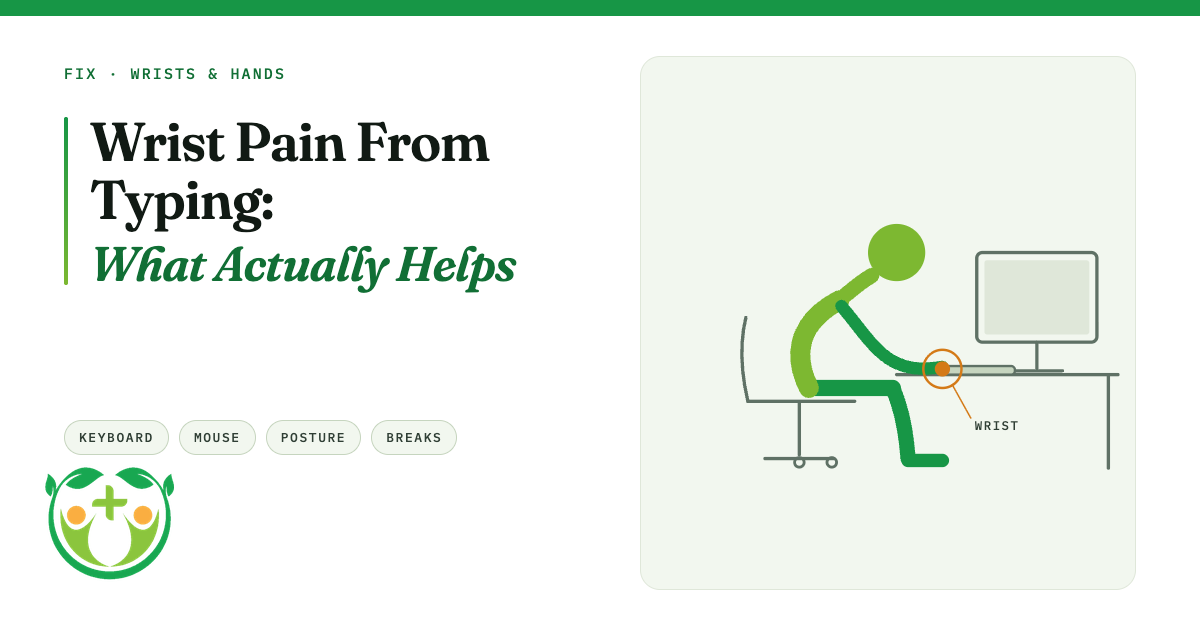
OSHA’s workstation guidance adds the setup side. A keyboard that is too low can make you type with your wrists bent up. A keyboard that is too high pushes your shoulders up. A traditional keyboard can also make you bend your wrists sideways to reach all the keys, and a steep keyboard tilt can bend the wrist upward. OSHA says these awkward postures can put stress on the tendons that move through the wrist during repetitive keying (OSHA).
The NHS also notes that arm pain is often a mix of causes, including aging, so a perfect desk is not a guarantee (NHS).
What to do today
1. Straighten the wrist line. OSHA’s target is hands, wrists and forearms straight, in line and roughly parallel to the floor, with elbows close to your body and bent between 90 and 120 degrees (OSHA). In practice: look at your wrists from the side. If they kink up or down, or angle outward toward the little finger, that is what to fix first.
2. Bring the keyboard to elbow height. OSHA says your elbows should be about the same height as the keyboard and hang comfortably to the side, with relaxed shoulders. If the desk or chair can’t be adjusted to get there, a keyboard tray that adjusts in height and tilt may help (OSHA). Keep the keyboard directly in front of you, with your forearms about parallel to the floor.
3. Check the keyboard tilt. OSHA says to avoid the little feet on the back of the keyboard if they make your wrist bend more. If you sit low relative to the keyboard, raising the back slightly can help. If you sit high, raising the front can help. The aim is a straight wrist, not any particular tilt (OSHA).
4. Pad hard edges. A hard desk edge pressing on your wrist or forearm can cause tingling and sore fingers. OSHA suggests padding the edge (for example with pipe insulation), using a wrist rest, or choosing furniture with rounded edges (OSHA).
5. Take short breaks, often. HSE says there is no legal guidance on exact break length, but short frequent breaks beat long rare ones: “5 to 10 minutes every hour is better than 20 minutes every 2 hours”. Breaks should let you get up and move, or at least stretch and change posture (HSE). Treat that as a starting point, not a rule.
6. Ease a flare, don’t immobilize it. The NHS suggests staying active, with less activity at first and building back up gradually. For pain it suggests paracetamol or an anti-inflammatory such as ibuprofen (tablets or gel), or a cold pack or bag of frozen peas wrapped in a towel on the sore area for up to 20 minutes every 2 to 3 hours (NHS). A pharmacist can help you choose what suits you.
7. Ask about your workload. The NHS says to speak to your employer about changing the way you work or reducing hours if the problem is work-related (NHS). If you work for yourself, the same idea applies: split long typing blocks with other tasks such as calls or reading.
Wrist exercises: what the evidence says
The Chartered Society of Physiotherapy publishes simple hand and wrist exercises written for carpal tunnel syndrome: wrist bends, a wrist lift, a wrist flex stretch, finger bends and a hand squeeze, usually 3 sets of 10 with holds of 5 seconds (CSP). The NHS says there is “a small amount of evidence” that hand exercises ease carpal tunnel symptoms (NHS).
Two honest limits. These exercises were written for carpal tunnel, not for general typing aches, and I did not find a trial of them for typing-related wrist pain. And “small amount of evidence” means don’t expect a fix. If an exercise makes the pain or tingling worse, stop. A physiotherapist can show you exercises that fit your own problem; the NHS notes that a physiotherapist can also help with posture and strengthening (NHS).
What has little proof
- Special keyboards. OSHA says alternative keyboards can help you keep neutral wrist postures, but that available research does not provide conclusive evidence they prevent discomfort or injury (OSHA). If one feels better to you, fine. Don’t buy one expecting a cure.
- Painkillers for the cause. For carpal tunnel, the NHS says painkillers may help short-term, but there is little evidence they treat the cause, so don’t rely on them (NHS).
- Long rest. See above: more than a few days of rest is not advised for RSI.
Is it RSI or carpal tunnel?
They overlap, and only a clinician can tell you which you have. The NHS lists carpal tunnel symptoms as an ache or pain in the fingers, hand or arm, numb hands, tingling or pins and needles, and a weak thumb or difficulty gripping. They often start slowly, come and go, and are usually worse at night (NHS). The CSP adds that hanging your hand out of bed or shaking it often relieves the tingling, and that similar symptoms can come from pressure on nerves in the neck (CSP).
If it is carpal tunnel, the NHS says a night splint that keeps the wrist straight can help, and you may need to wear it for up to 6 weeks before it feels better (NHS). It’s worth asking a pharmacist or GP before buying one.
When to see a doctor
The NHS says to see a GP if (NHS RSI, NHS carpal tunnel):
- RSI symptoms are not going away or are getting worse
- carpal tunnel symptoms are getting worse or not going away
- treatment at home isn’t working
The CSP says it is important to get help quickly if your hand muscles are weak (CSP). The NHS adds that in many areas you can refer yourself to community musculoskeletal (MSK) services, such as physiotherapy, without a GP referral (NHS). Most people with RSI can manage symptoms and get better without further treatment, but if yours doesn’t improve, physiotherapy or occupational therapy are the usual next steps (NHS).
Quick recap
- Wrists straight, forearms roughly parallel to the floor, elbows at keyboard height.
- Fix the cause first: keyboard height and tilt, hard edges.
- Short breaks often, not one long one.
- Stay active; don’t rest the arm for more than a few days.
- Tingling, numbness, weak grip or worsening pain: get it checked.
Related on Nerdz Health: 11 ways to stay healthy when you sit at a desk all day · The 10-minute desk reset routine · All Fixes · How we research
Sources (7)
- NHS, Repetitive strain injury (RSI). https://www.nhs.uk/conditions/repetitive-strain-injury-rsi/ (page last reviewed 28 May 2026, next review due 28 May 2029; read 16 Nov 2026)
- NHS, Carpal tunnel syndrome. https://www.nhs.uk/conditions/carpal-tunnel-syndrome/ (last reviewed 17 Apr 2024, next review due 17 Apr 2027; read 16 Nov 2026)
- OSHA, Computer Workstations eTool: Keyboards. https://www.osha.gov/etools/computer-workstations/components/keyboards (read 16 Nov 2026)
- OSHA, Computer Workstations eTool: Good Working Positions. https://www.osha.gov/etools/computer-workstations/positions (read 16 Nov 2026)
- OSHA, Computer Workstations eTool: Desks. https://www.osha.gov/etools/computer-workstations/components/desks (read 16 Nov 2026)
- HSE, Work routine and breaks. https://www.hse.gov.uk/msd/dse/work-routine.htm (read 16 Nov 2026)
- Chartered Society of Physiotherapy, Exercise advice: carpal tunnel syndrome. https://www.csp.org.uk/public-patient/rehabilitation-exercises/carpal-tunnel-syndrome (read 16 Nov 2026)